Preface
Why a second book
My first book, How Can I Bear the Suffering?, grew out of an exchange of letters. Someone in deep distress had asked me a single question, and over many months we searched for answers together. Inside those pages stand sentences like: “Nothing—absolutely nothing at all—takes place out there.” Or: “There is no ‘out there.’”
I stand by those sentences to this day. The world out there has no reality of its own. It is projection, mirror, stage set. In that first book, I used the metaphor of a movie theater: we sit in our seats and mistake the film projected onto the screen for reality. I also told the story of The Truman Show, in which a man discovers that his entire world is a set—and in the end, walks out through a door marked “Exit.”
This book tells what happens next. Because the story doesn’t end the moment you see through the stage set. That’s where it truly begins. Once you realize the world is a stage set, you face a choice: you can stay outside, in the empty space behind that exit door—or you can walk back in, step onto the set, and play your part. Only this time, you know.
Truman goes back inside. That’s what this book is about.
Between worlds
I know what I’m talking about when I warn against staying outside. I stayed out there for years.
In the Gospel of John, Jesus says of his followers roughly that they are in the world, yet not of the world. That has long been held up as a spiritual ideal. I came to know its shadow side. I was in the world, yet I no longer belonged to it. And right there lay the imbalance I slid straight into.
Today, I call it a spiritual depression. Everything felt pointless. The hustle of the world with all its dramas left me completely indifferent. Working with people felt exhausting. Everything was exhausting and futile. I had recognized that the world had no reality of its own—yet I had jumped to the conclusion that it had no value, either. And so I hung suspended between worlds. The old one had slipped away from me, and I hadn’t found a new one.
Eventually, that shifted—not through a new method, and not through some grand illumination. More the way the herdsman in the ancient Zen pictures walks back into the marketplace at the very end. I came back. And out in the marketplace of the world, the question of meaning and purpose stops coming up—because it no longer needs asking. The world out there is the way it is because I am the way I am. I am the creator of this world. How could it possibly be meaningless?
This isn’t a counter-argument to the first book. It is its second half. “There is no ‘out there’” is half the truth. Anyone who stops there lands right where I landed. The other half goes like this: precisely because there is no “out there,” everything I encounter out there is mine—my mirror, my teacher, my path.
Mirror instead of illusion
The core thesis of this book can be stated in a single sentence: The world has no intrinsic value, yet it has use value.
You can ignore an illusion. You cannot ignore a mirror. Without a mirror, nobody ever sees themselves. The boss who drives me up the wall, the letter that makes my stomach drop, the body growing tired, the person dying—none of that is an obstacle blocking the path. It is the path. Everyday life is the fuel on which awakening catches fire.
The provocation of this book isn’t aimed at the statement that the world is an illusion. It is aimed at everyone who stops right after saying it. Seeing through the illusion is only half the journey. The other half is putting it to use.
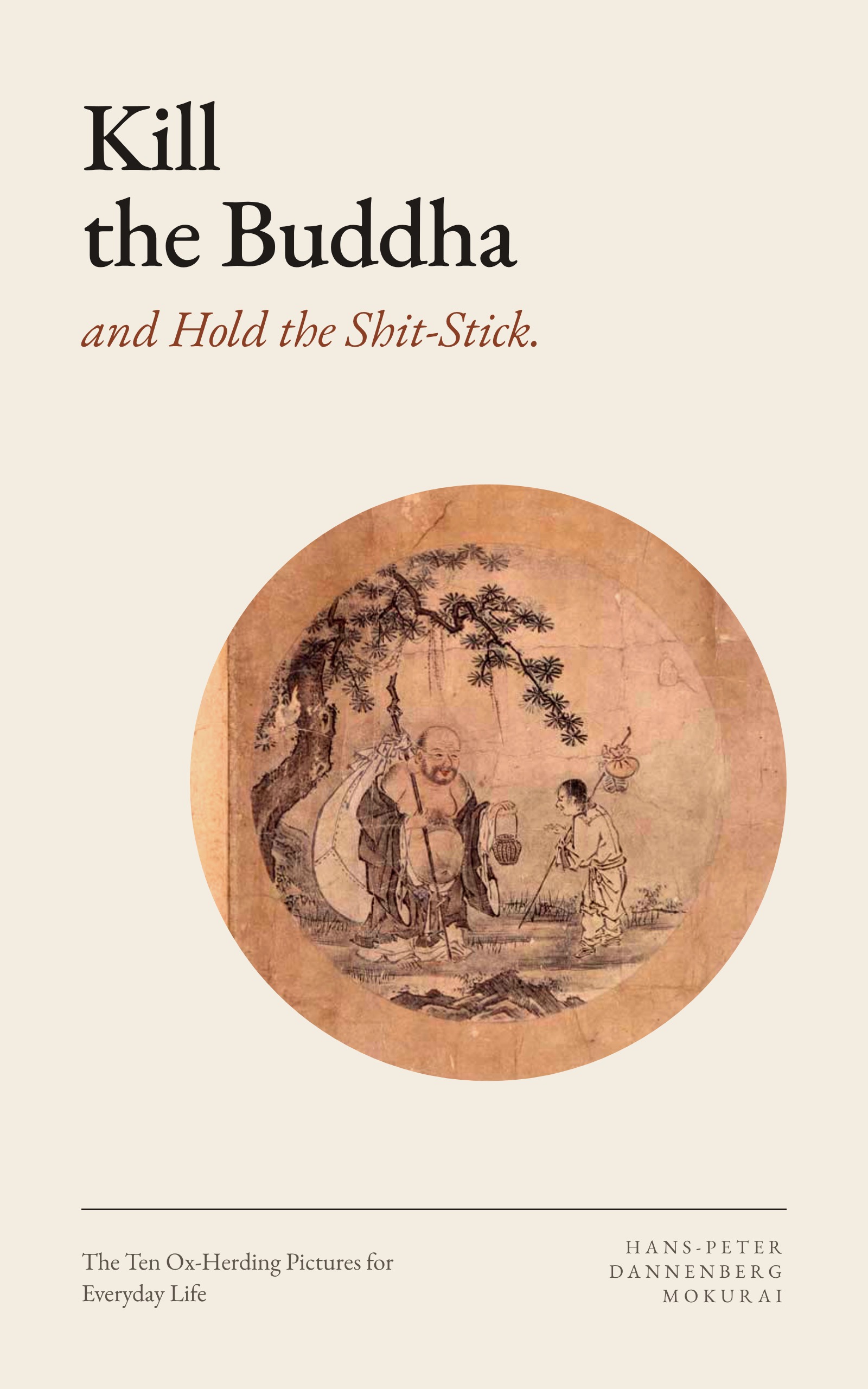
As a through-line, I chose the Ten Ox-Herding Pictures of Zen. They tell the story of a herdsman searching for his ox—his true nature—finding it, taming it, forgetting it, and finally returning to the marketplace with open hands. Each chapter follows one of these pictures and tracks down where it lives in everyday life. Every chapter opens with a scene, asks what the old masters have to say, reads that ancient wisdom against the grain, and ends with a practical tool for daily life.
The voices speaking in these pages come from Zen and Advaita Vedanta, from the Bible and the Gospel of Thomas, from A Course in Miracles, and from Elio D’Anna’s The School for Gods. D’Anna, in particular, gave me plenty to push against: where he’s sharp, I follow him; where he goes too far, I push back. Even quantum physics makes a brief cameo—as a metaphor, never as proof.
A word of caution
What I call “spiritual depression” hits plenty of people on this path—more than you might think. That emptiness, that sense of futility, that feeling of hovering between worlds can be a passing phase. Yet it can also feel just like clinical depression, or actually be one. If that’s where you are right now, give yourself permission to seek outside help alongside any spiritual path—from a doctor, a therapist, someone you trust. That isn’t a betrayal of the path. It is part of it. Help comes from the marketplace, too.
A note on reading
This book speaks directly to you, just like the first one did. At times it draws from my own life, yet it isn’t about me. It’s about the path that runs straight through everyday life—and you’re the one walking it. Read at your own pace. Try out the tools that speak to you and leave the rest on the table. And if a sentence rubs you the wrong way, take a closer look at it. It might just be an opponent.
Hans-Peter Dannenberg (Mokurai)
Chapter 1 – Searching for the Ox
The search
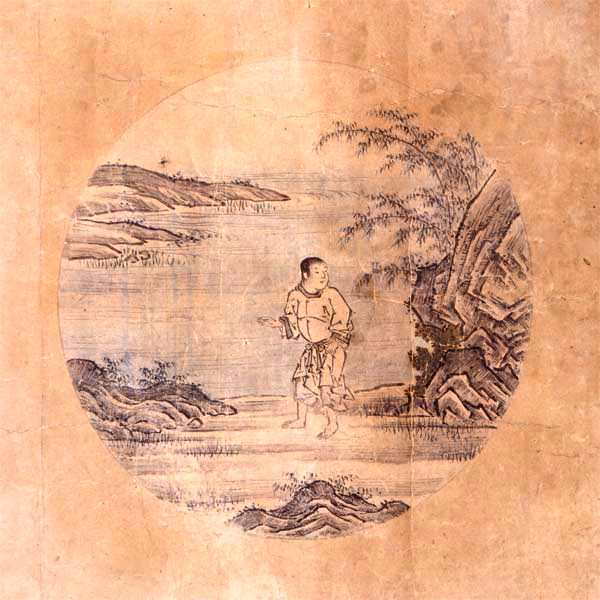
The first picture: A herdsman runs blindly through the wilderness—over mountains, across rivers, through thick grass. He is searching for his ox. He’s exhausted, confused, and no longer even knows which direction to turn. What he doesn’t know is that the ox never ran away.
That is the start of every spiritual path. And it’s a pretty embarrassing start at that. Here is someone sprinting around trying to find something they never lost—looking everywhere except the one place it actually is.
I know this herdsman well. I was him for a long time. And to be completely honest, I’m not sure I’m not still him sometimes.
The sneaky thing about searching is that it doesn’t feel like searching. It feels like a goal. Like a game plan. Like ambition, passion, a life’s mission. You only realize you’ve been searching once you finally find what you were looking for—and discover it isn’t what you were looking for after all.
Three feet past the finish line
In my early twenties, I read an article about the Ironman World Championship in Hawaii—a 2.4-mile swim in the Pacific, a 112-mile bike ride across lava fields, followed by a full marathon. I read those numbers and knew immediately: I have to do this. No matter what.
Why? Back then, I would have said it was for the challenge, for pushing my limits. Today, I know better. I had always carried a massive hunger to do things that would earn me recognition. And where do you get more recognition than finishing the Hawaii Ironman? It’s the Mount Everest of endurance sports. Whoever crosses that finish line is somebody.
An equation had locked itself into my head: Once I pull that off, I’ll have made it. I’ll be done with life, in the best possible sense. I could even die right afterward, and everything would be complete.
And then it actually happens. I’m standing at the starting line in Kona. I swim, I bike, I run. I cross the finish line. Just beforehand, over the final miles, I’m overflowing with joy.
And then, three feet past the finish line, a single thought drops in. No cheering inside, no salvation—just this:
Well. Now what?
That was it. The monumental goal I had staked everything on had been achieved. And it lasted for exactly three feet.
The chapel
Yet I had already held the answer in my hands years earlier. I just hadn’t recognized it as an answer.
I’m fifteen or sixteen when my grandmother dies. We were very close, the two of us. I am deeply, profoundly sad.
She is laid out in a chapel, and my mother wants my sister and me to go in and say goodbye. I’m terrified of it. I’ve never seen a dead person before, and I’m afraid of seeing my grandma like that—imagining she’ll look awful, that all the suffering will still be etched across her face.
Then I’m standing there. And there she lies. And there is nothing awful about it at all. There is complete peace. Total stillness.
Inside me, something rises up that I never expected—least of all standing beside a coffin. Something almost euphoric. A thought that doesn’t arrive like a normal thought, more like an unshakable certainty: Whatever is lying there has nothing to do with who my grandmother really is.
Along with it comes an overwhelming sense that she is okay—that she is safe and held. Every bit of grief vanishes.
Around that same time, I buy my first Zen book. I don’t understand a single word of it, yet I have to have it. Something inside me already knows where it wants to look, even if the rest of me hasn’t got a clue yet.
Back then, I didn’t grasp what had happened in that chapel. So a few years later, I flew all the way to Hawaii to look for it somewhere else.
End of sample. The complete book: paperback and e-book on Amazon.